
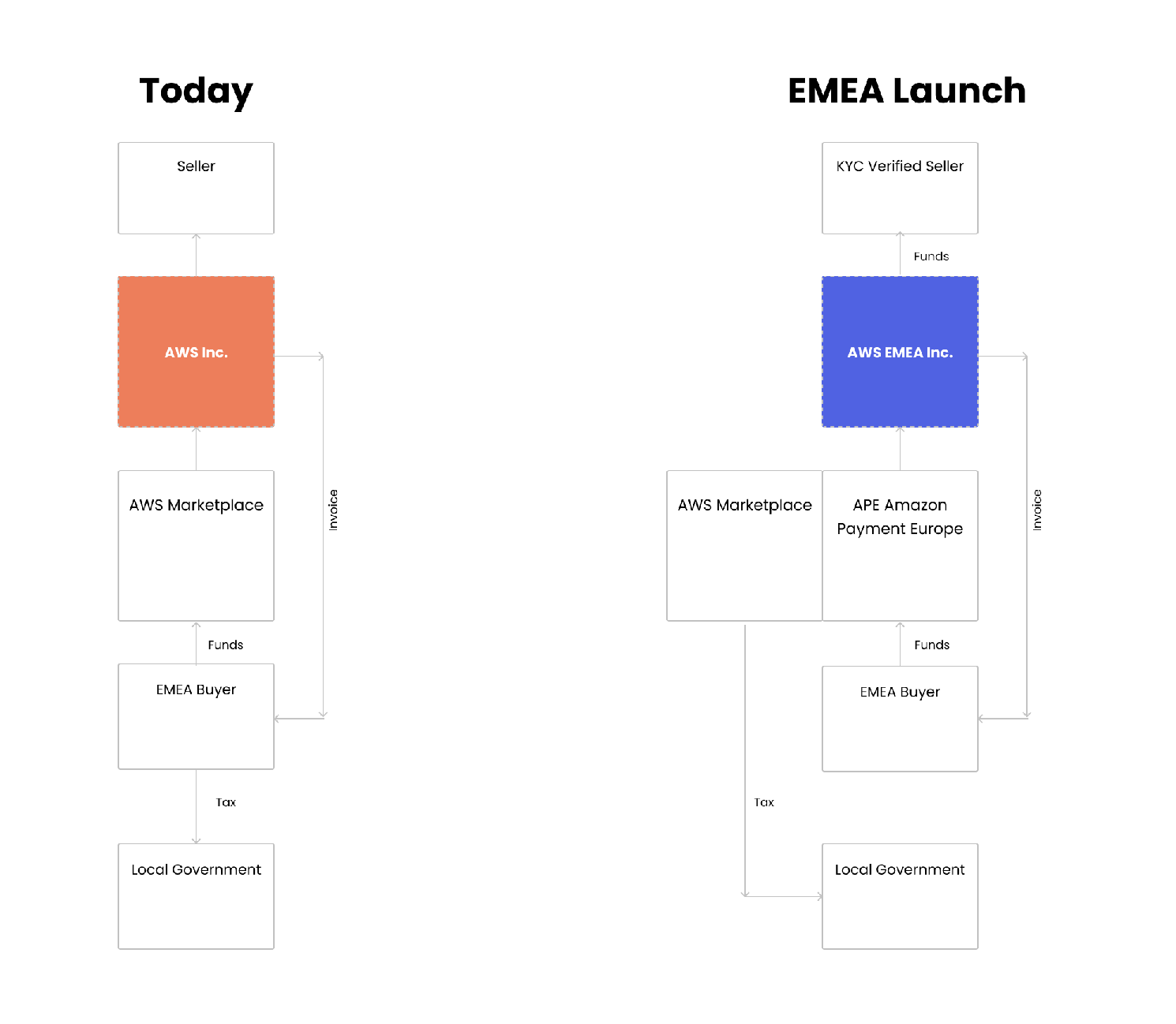
Today for the AWS and AWS Marketplace purchases EMEA buyers receive bills from different money institutions. WIth this launch buyers will receive bills from same legal entity which reduces thier AR and payment complexities.
It's a long process for buyers to calculate, self asses and remit taxes to their local government. With this launch Marketplace simplifies the process.
It is likely that buyer may interact with a fraudulent seller. With Know your customer and EMEA launch, Marketplace will conduct ongoing compliance including KYC and Suspicious activity monitoring to ensure safety and security of buyers.
As we learnt more about the mindset of sellers and buyers and aligned them with the business goals with the tenets defined.
Onboard 200+ sellers with high Gross Software sales in EMEA region to KYC compliance. Verify the credibility, point of contact and benefiicial owner of the company.
Allow sellers to sell their softwares
to EMEA buyers and not restrict the products. Allow funds to be
transacted through US entity.
As we learnt more about the mindset of sellers and buyers and aligned them with the business goals with the tenets defined.
Preserve the product catalog for
EMEA buyers to have variety of product to select from.
Main KYC flow target persona is root account user ex. Admin role. This flow comprises of wizard with multiple steps that seller has to complete in order to successfully complete the KYC process. Users are taken to another portal to complete the entire process.
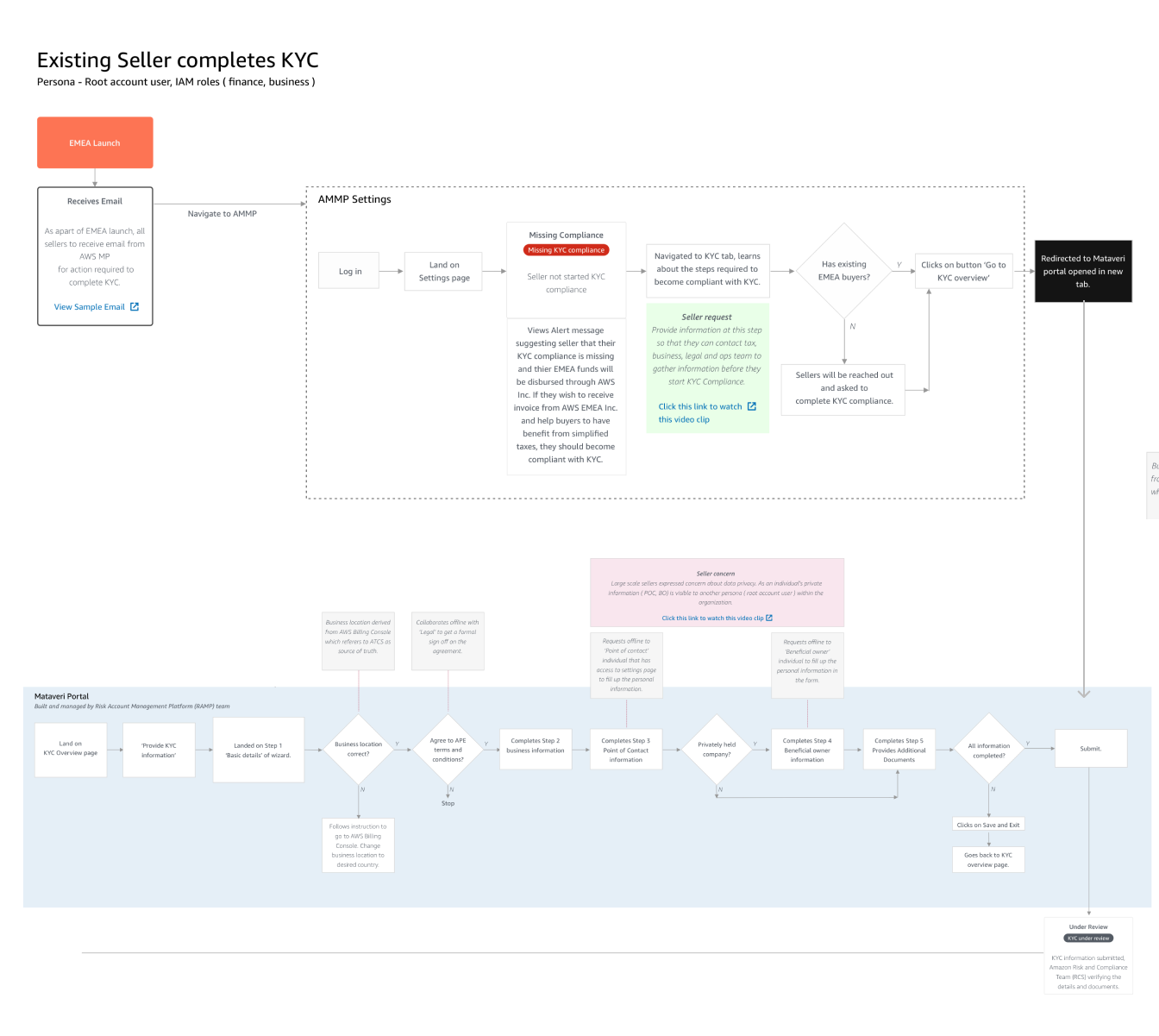

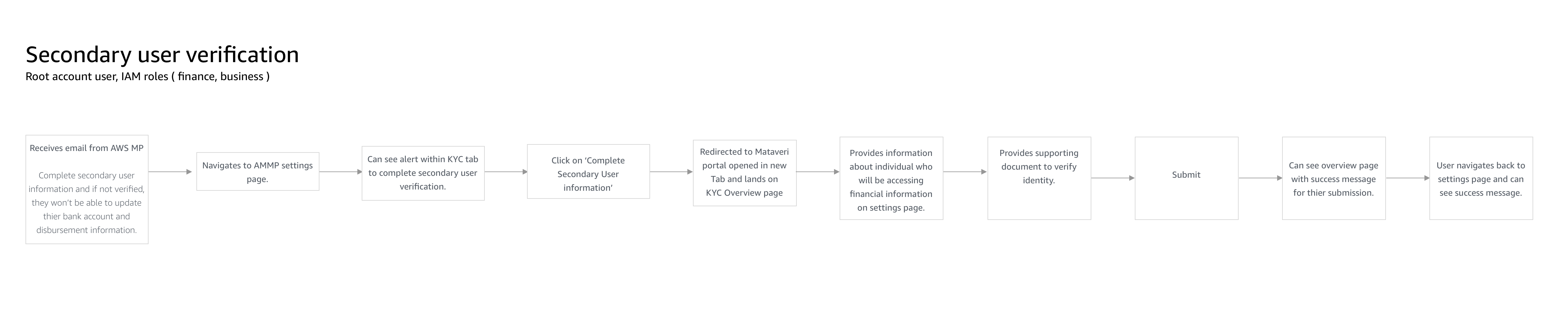
KYC process involves multiple touch points such as Company type, Company name, Business location, Registration number, Point of contact information, Beneficial owner information, supporting documents etc. This information generally not available to the Persona in consideration, the user has to navigate internally within their organization or have IAM roles created for finance, management, legal etc to review and provide the information or approve the terms.

User with credential giving them access to entire Marketplace account.
KYC process involves multiple touch points such as Company type, Company name, Business location, Registration number, Point of contact information, Beneficial owner information, supporting documents etc. This information generally not available to the Persona in consideration, the user has to navigate internally within their organization or have IAM roles created for finance, management, legal etc to review and provide the information or approve the terms.

User with IAM role permission from departments such as finance are requested to complete bank account verification to continue receiving funds in their disbursement account.
KYC process involves multiple touch points such as Company type, Company name, Business location, Registration number, Point of contact information, Beneficial owner information, supporting documents etc. This information generally not available to the Persona in consideration, the user has to navigate internally within their organization or have IAM roles created for finance, management, legal etc to review and provide the information or approve the terms.

User with IAM role permission from departments such as finance are required to complete secondary user information to continue getting access for updating banking an disbursement information.
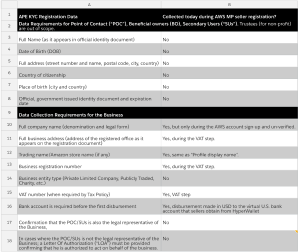
Data requirements and acceptance criteria defined with various stakeholders from the marketplace and kyc seller portal team. For the each data type API were discussed and agreed which provided input for designs to craft the UI.
Acceptance criteria defined helped in creating edge cases for various states such as before kyc, after kyc etc.


There were 2 different design systems involved. Polaris being the main design system for AWS Marketplace products, I had to learn the external team DS FLo.These design systems had their own components, designer as well as developer guidelines which had been followed and reviewed with the DS teams.
Also DS FLO was created for Amazon Retail seller portal and they already had widgets created to measure the metrics. I had to align with those widgets and then provide the new designs ensuring that their Metrics doesn’t get impacted.

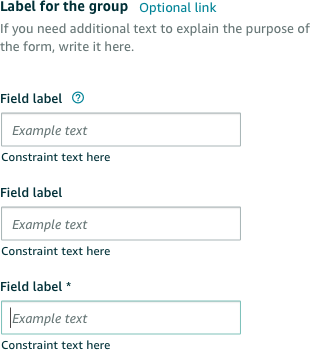
There were 2 different design systems involved. Polaris being the main design system for AWS Marketplace products, I had to learn the external team DS FLo.These design systems had their own components, designer as well as developer guidelines which had been followed and reviewed with the DS teams.
Also DS FLO was created for Amazon Retail seller portal and they already had widgets created to measure the metrics. I had to align with those widgets and then provide the new designs ensuring that their Metrics doesn’t get impacted.
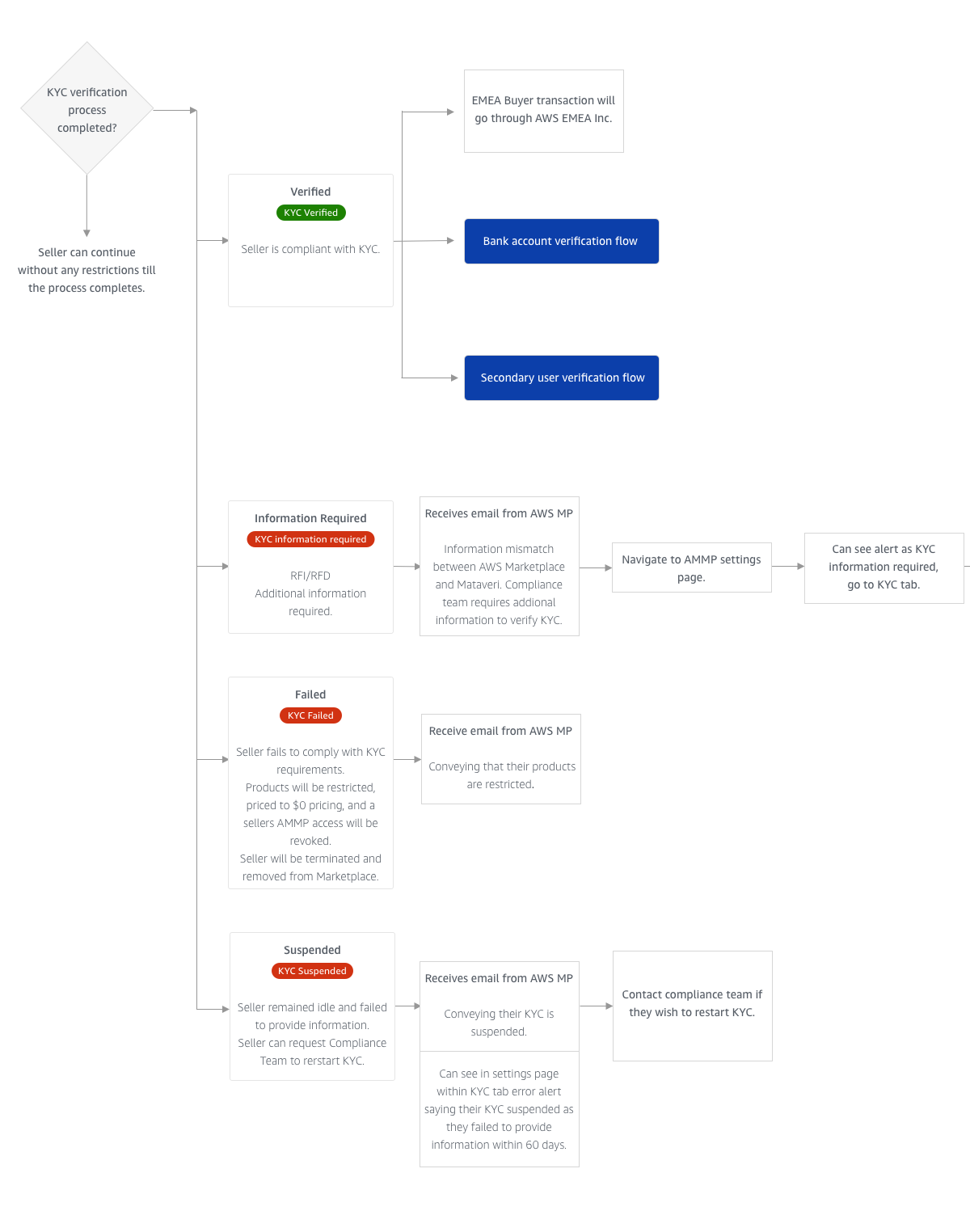
KYC has around 5 statuses. This includes KYC Missing compliance, KYC additional information required, KYC under verification, KYC verified, KYC Failed, KYC suspended, KYC Change of circumstances. The API’s for various statuses were called from the KYC portal and displayed at the AWS Marketplace settings page. These statuses eventually defines the further flow for user to follow.
After the primary user such as Root account user submits the KYC information on the seller portal, compliance team thoroughly investigates the information submitted by them to ensurer there are no suspicious activities and money laundering involved. Once all the conditions are satisfied the compliance team marks the seller as compliant. If for some reason the seller provided information has mismatch, compliance team requests for additional information via Marketplace settings.
To complete this process, sellers are provided with sufficient time around 60 to 90 days. This includes first time KYC submission, request for additional information etc.
Once the seller is validated, their profile showcases the status as KYC verified. With this they are requested to complete additional KYC compliance such as Bank account verification and Secondary user verification.
If KYC failed, and found suspicious then the seller profile would be removed.
For all the changes in their statuses, sellers are notified with email notifications about the change in their compliance status and the effect on their profile as a result of the same.

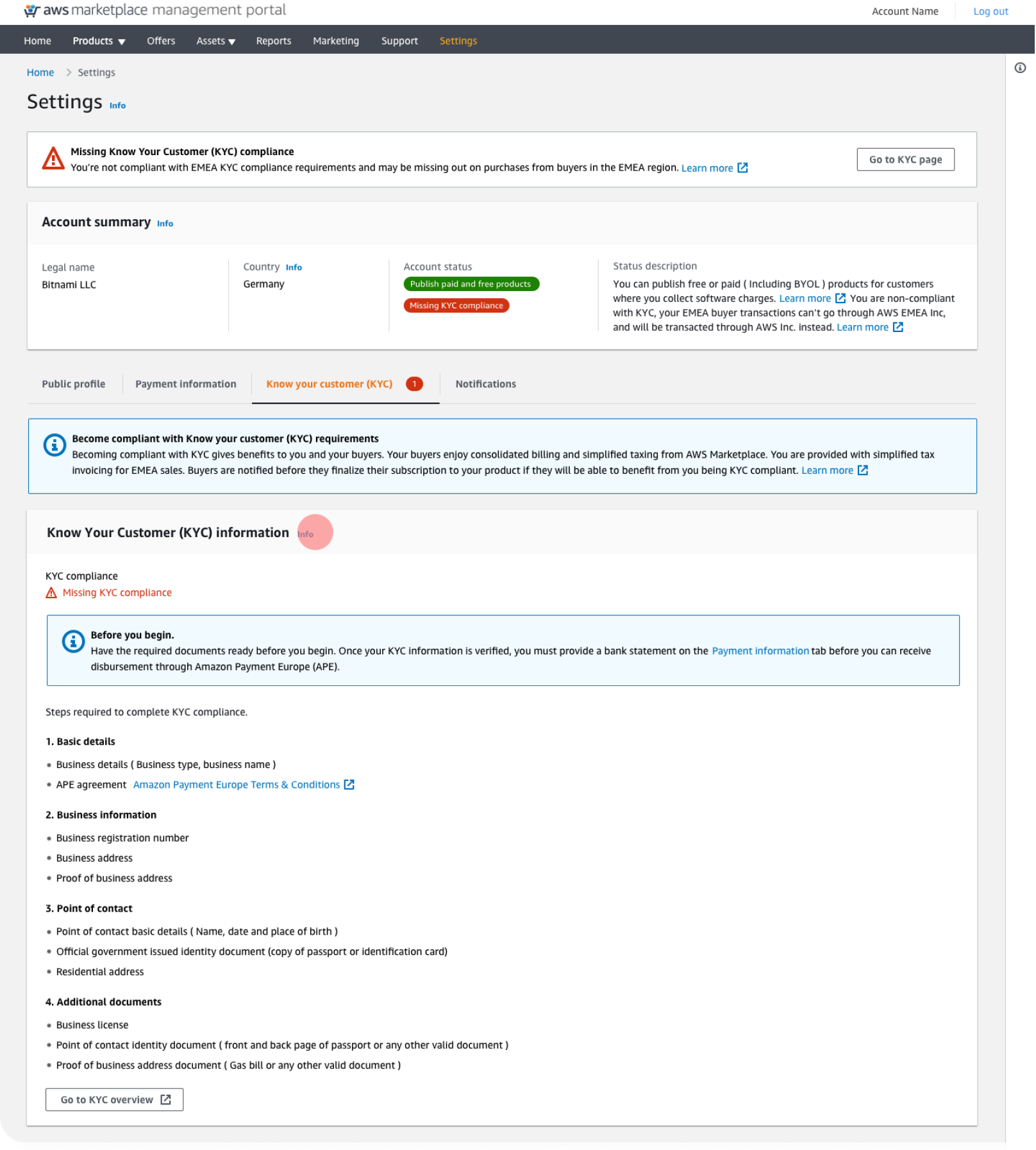
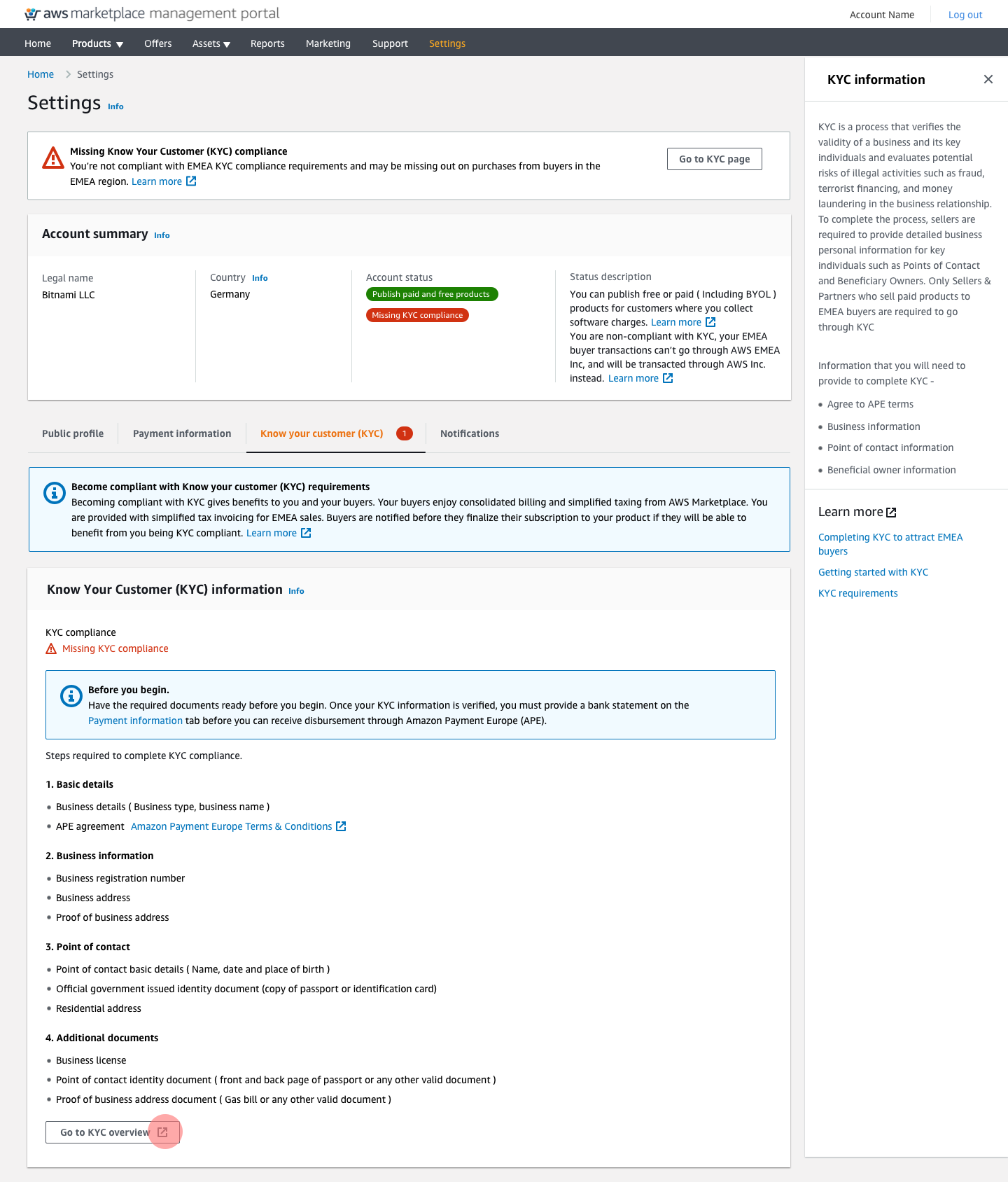
Sellers who have access to settings page can see the action alert on landing page
requesting them to complete KYC. They can learn more about the compliance by
vising the documentation link provided.
Account summary provides them status badge “Missing KYC” and a description explaining what the status means.
Proposed additional number badge for the KYC tab to indicate user about the action item pending.
.png)
KYC steps
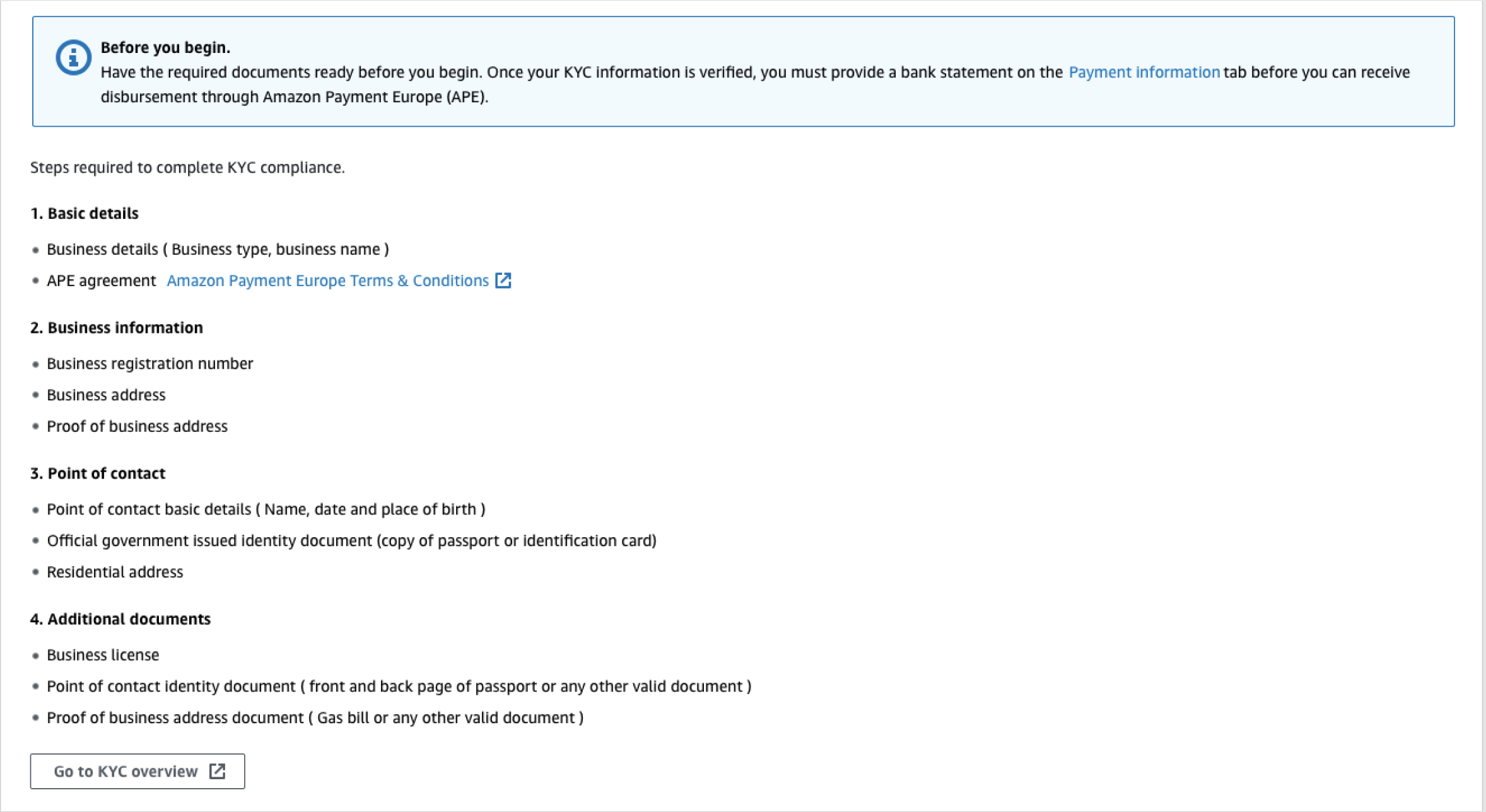
Steps to help seller to prepare and be ready with the information and documents.
Initial research suggests that Root account user needs to connect with legal, business and other stakeholders to gather the information at early stages, as this information is not readily available to main user.Sellers may also need to view the terms and conditions beforehand to ensure they are in agreement before starting their compliance journey.
Having a visibility around type of information required in each steps, gives seller room to prepare in advance.
It was observed in user testing that seller ofter would create a IAM role which provides access to stakeholder such as Point of contact to provide their personal information in one of the steps.They also reach out to legal, business and finance for the documentation such as business license.


Utilized 'Information Alert' components to describe and introduce a concept for sellers. These alerts defines What, Why and How for any concept.

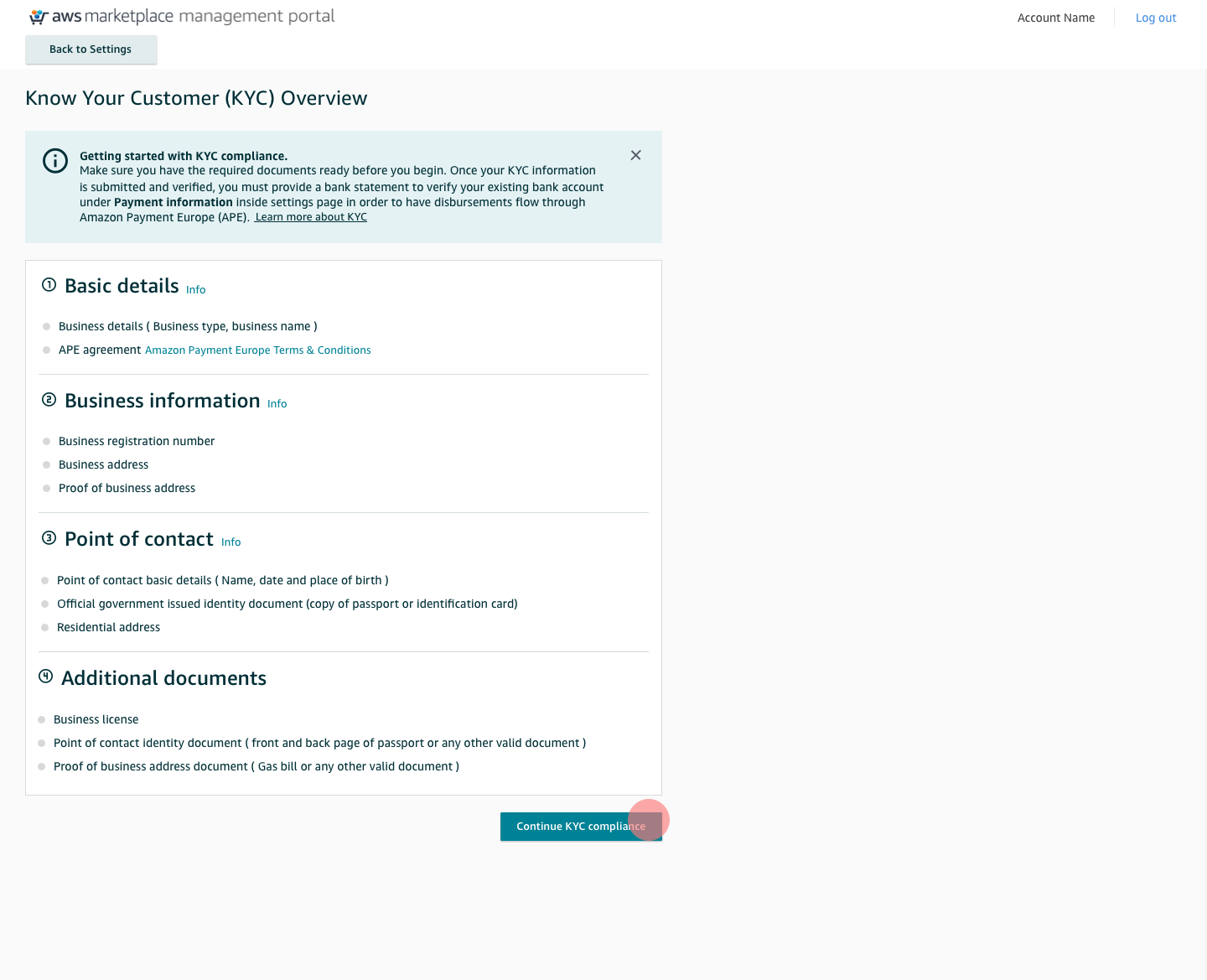
KYC process has multiple steps and huge scope. Amazon seller central is a platform which is the backend which collects all the seller information for AWS as well as for retail customers.
KYC Portal has been designed from scratch as a gateway which connects with seller central compliance platform, teams and processes. To build this platform, User Experience was crafted from scratch. FLO design system is used to craft designs.
Many API discussion were planned identify if various statuses can be sent back to Marketplace setting page. Depending upon API calls the respective statuses were designed in settings page.
Since it's a portal rendered outside of Marketplace, to make the experience seamless design decisions such as keeping branding on header to be consistent were taken. Also, provisions to come back to settings page was discussed and designed.
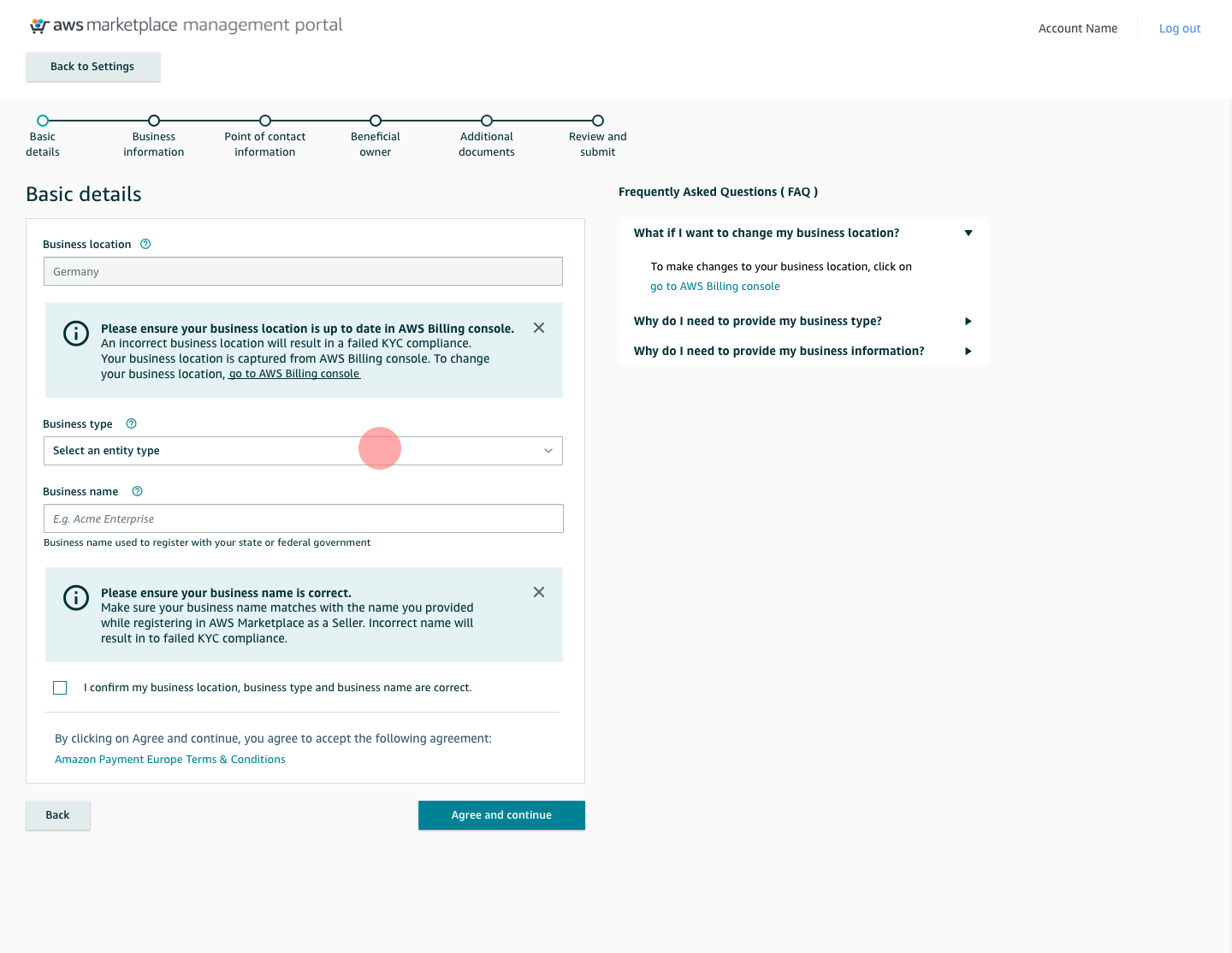
Step 2
Business details

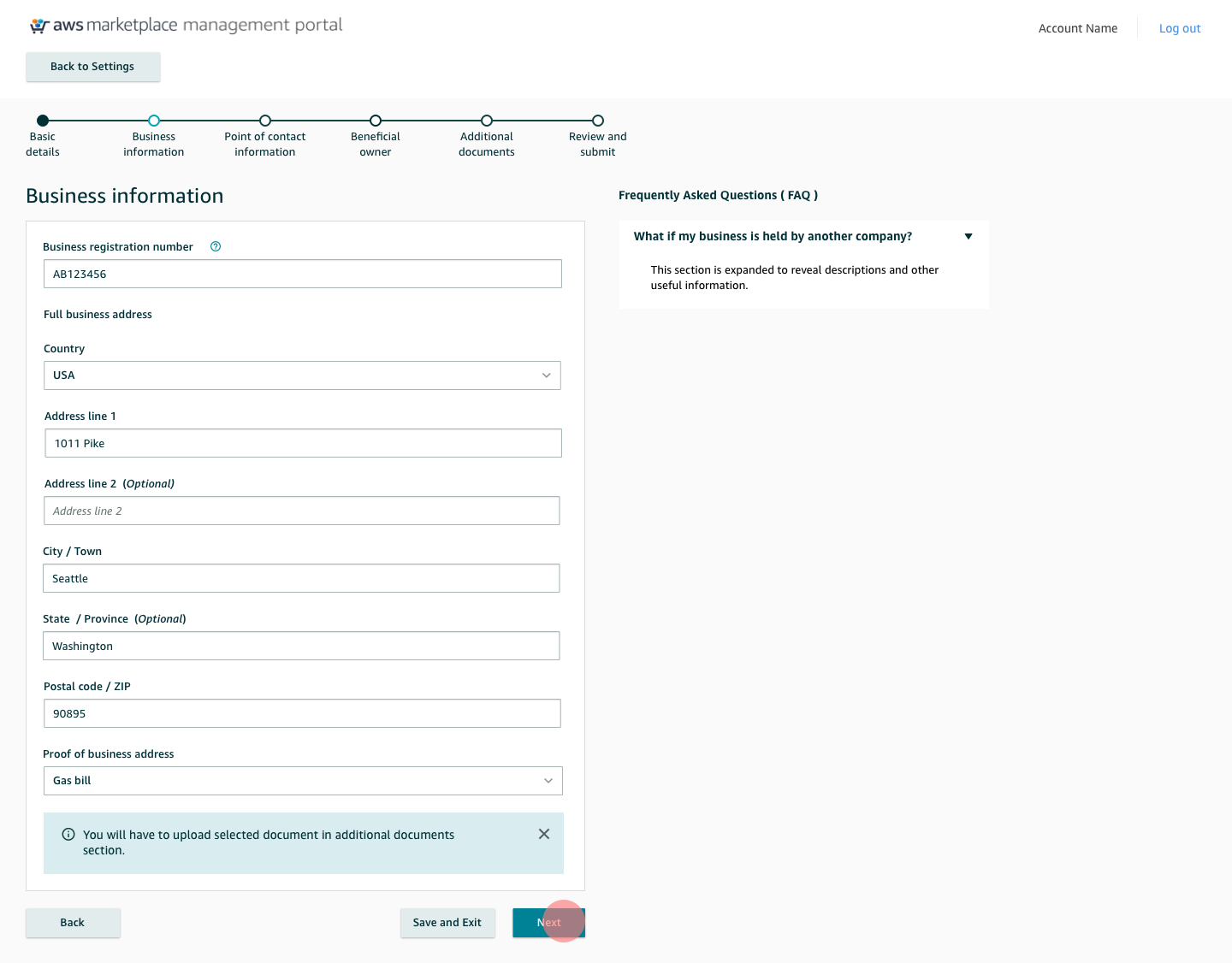
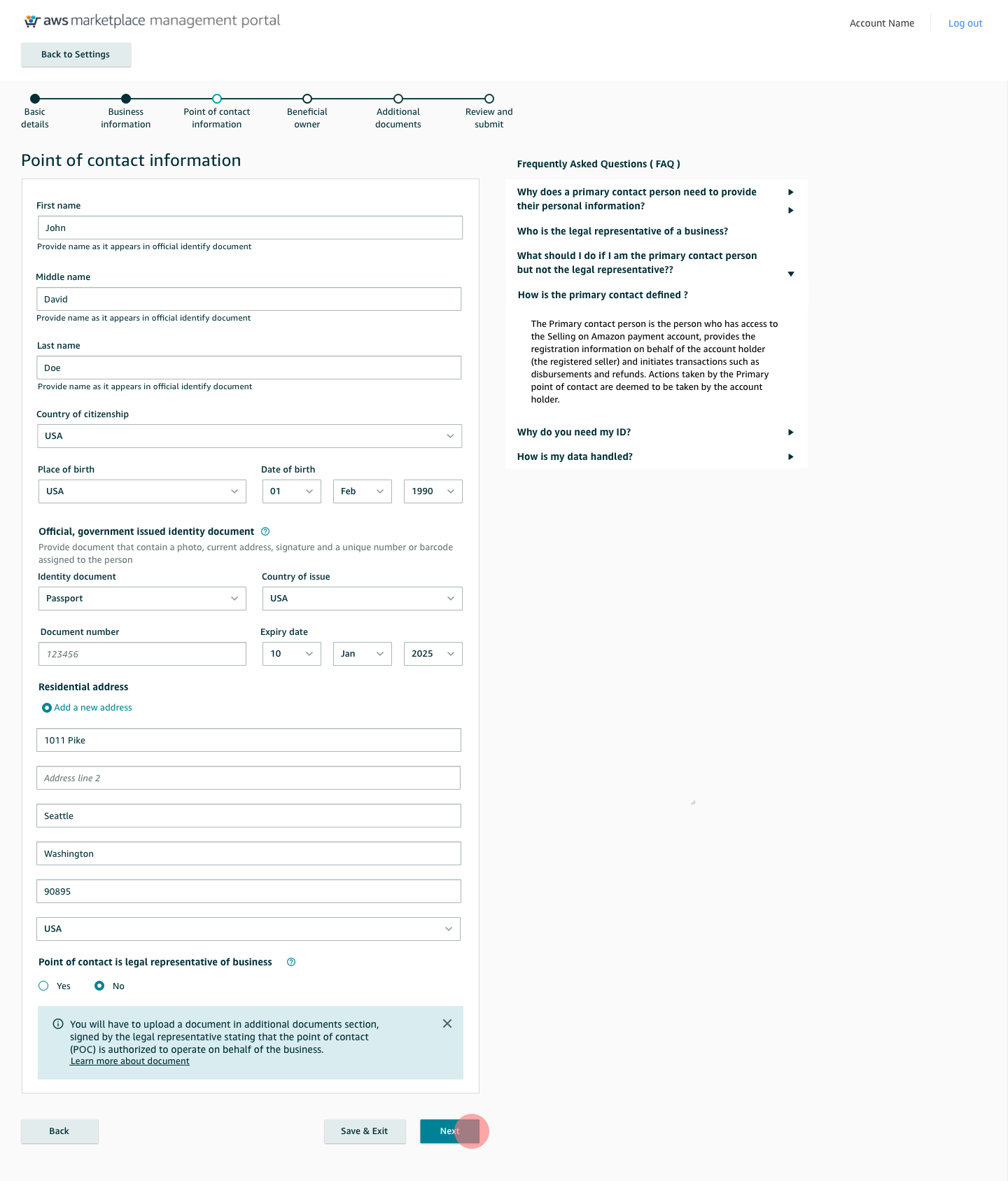
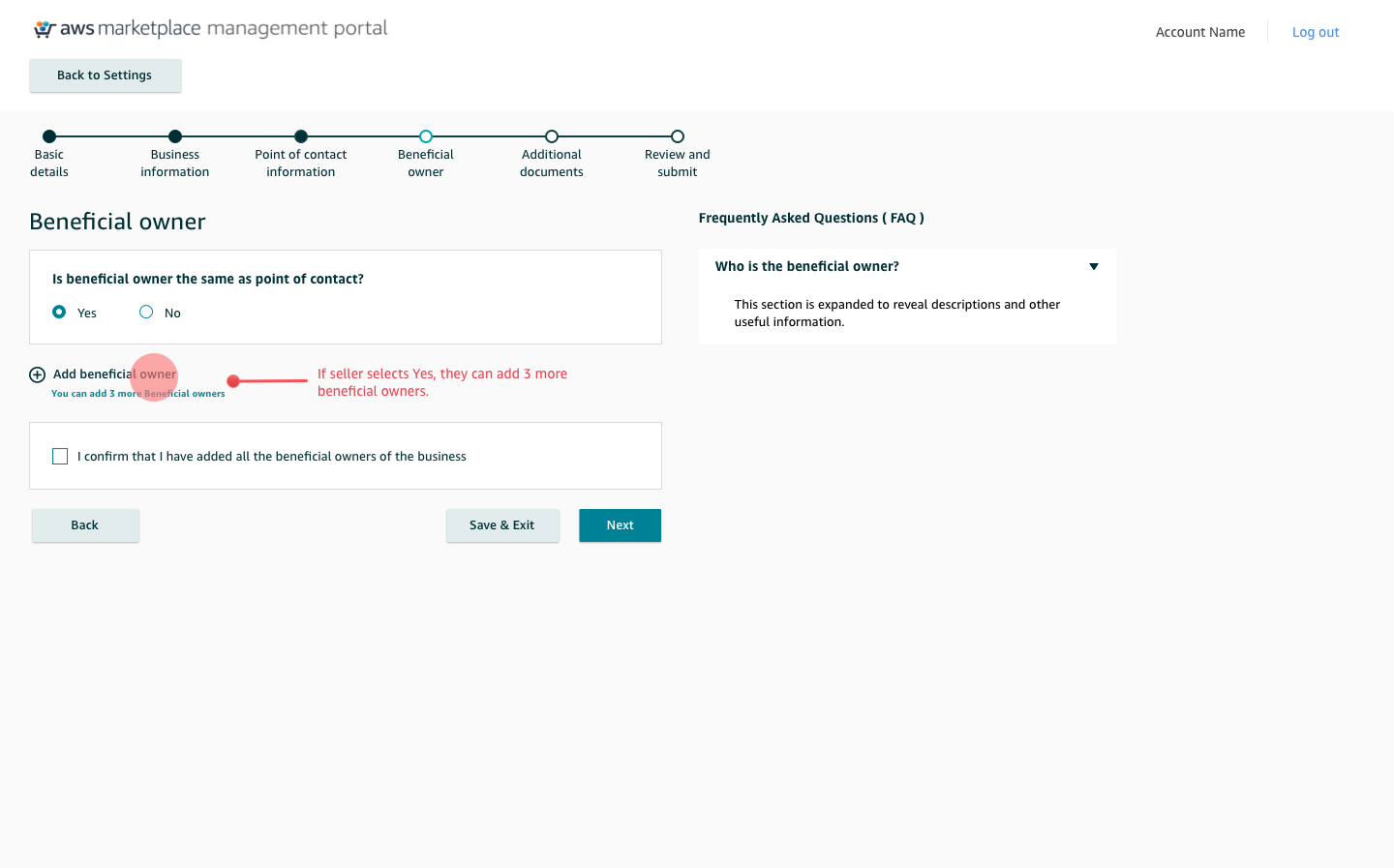
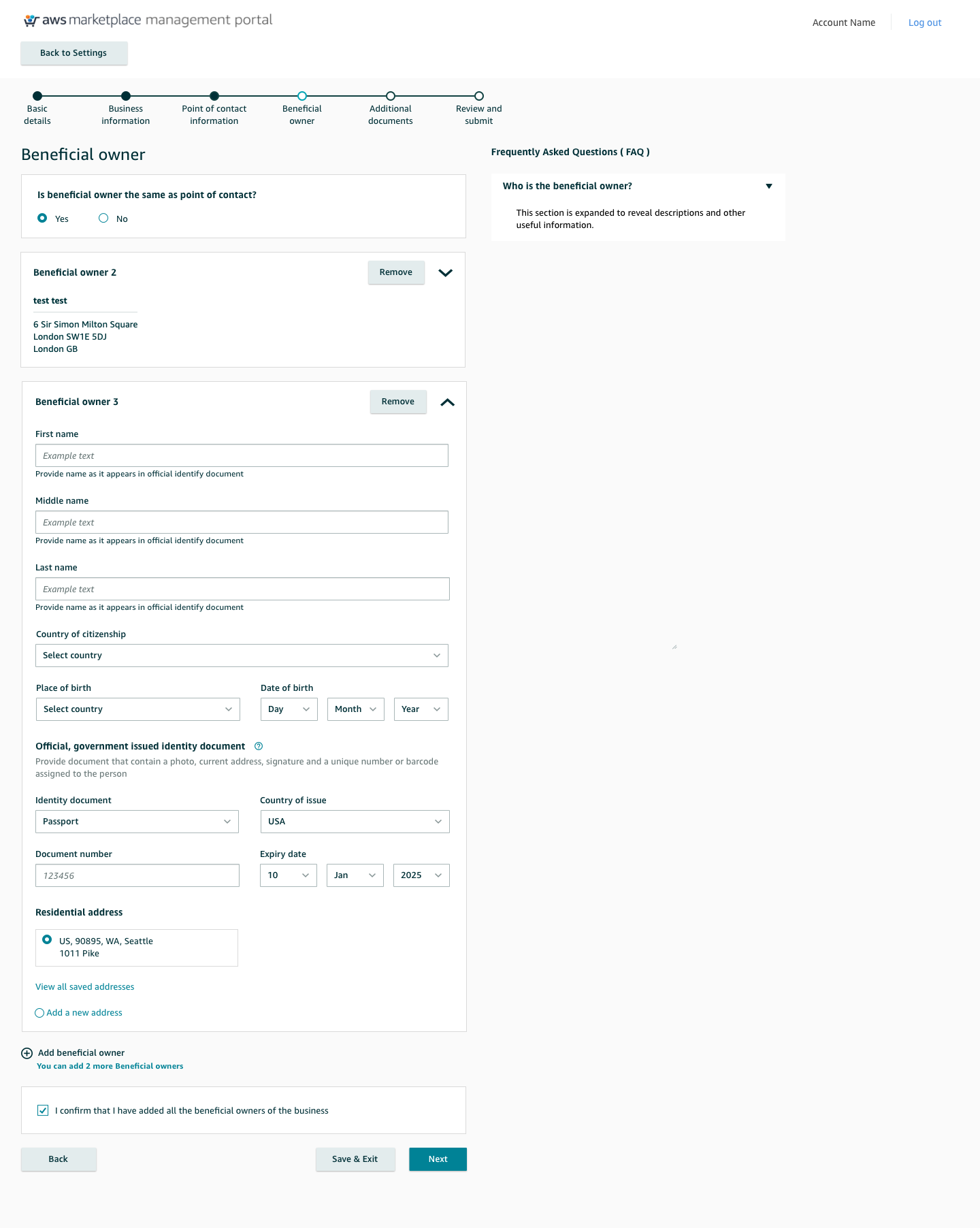
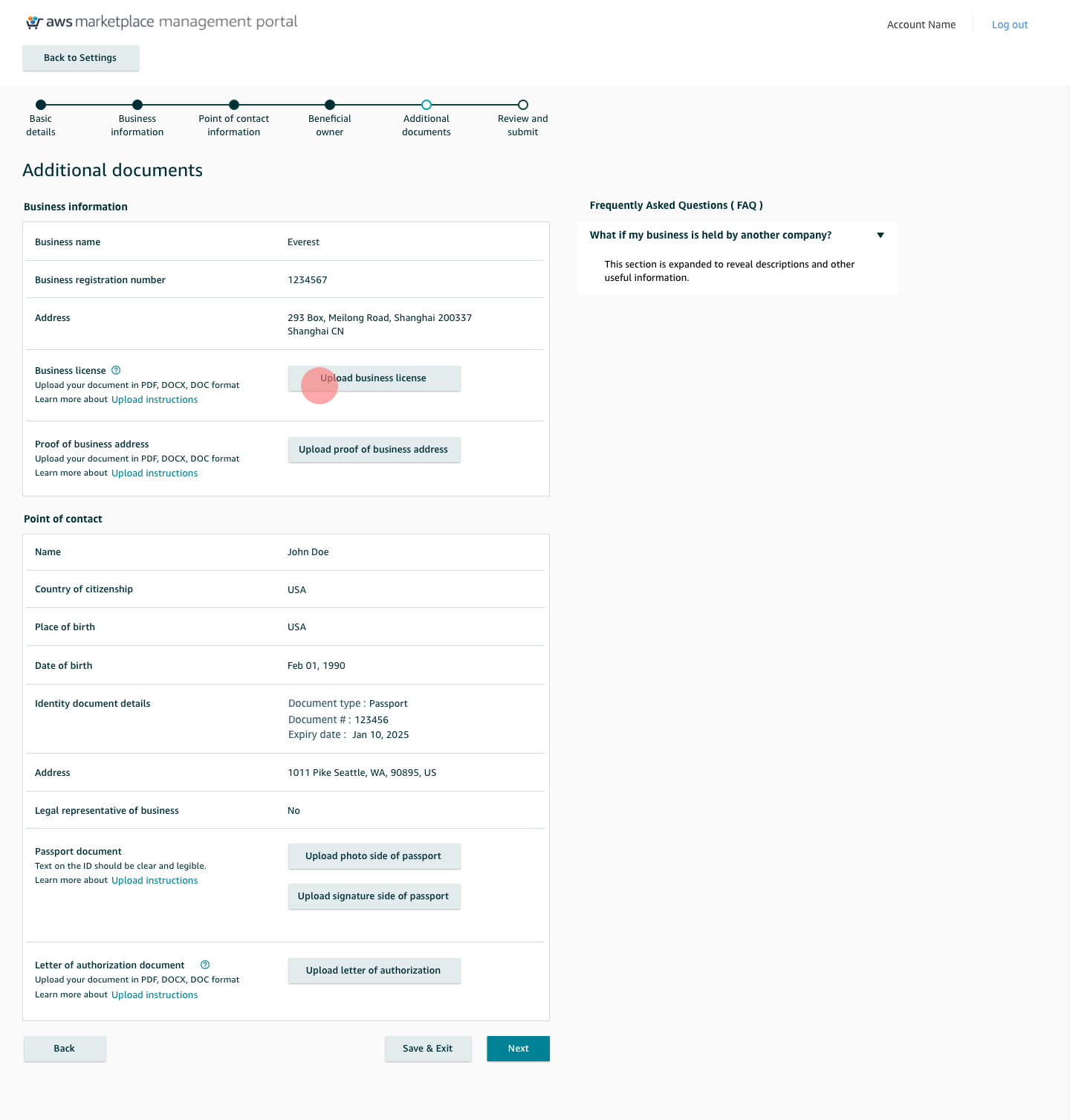
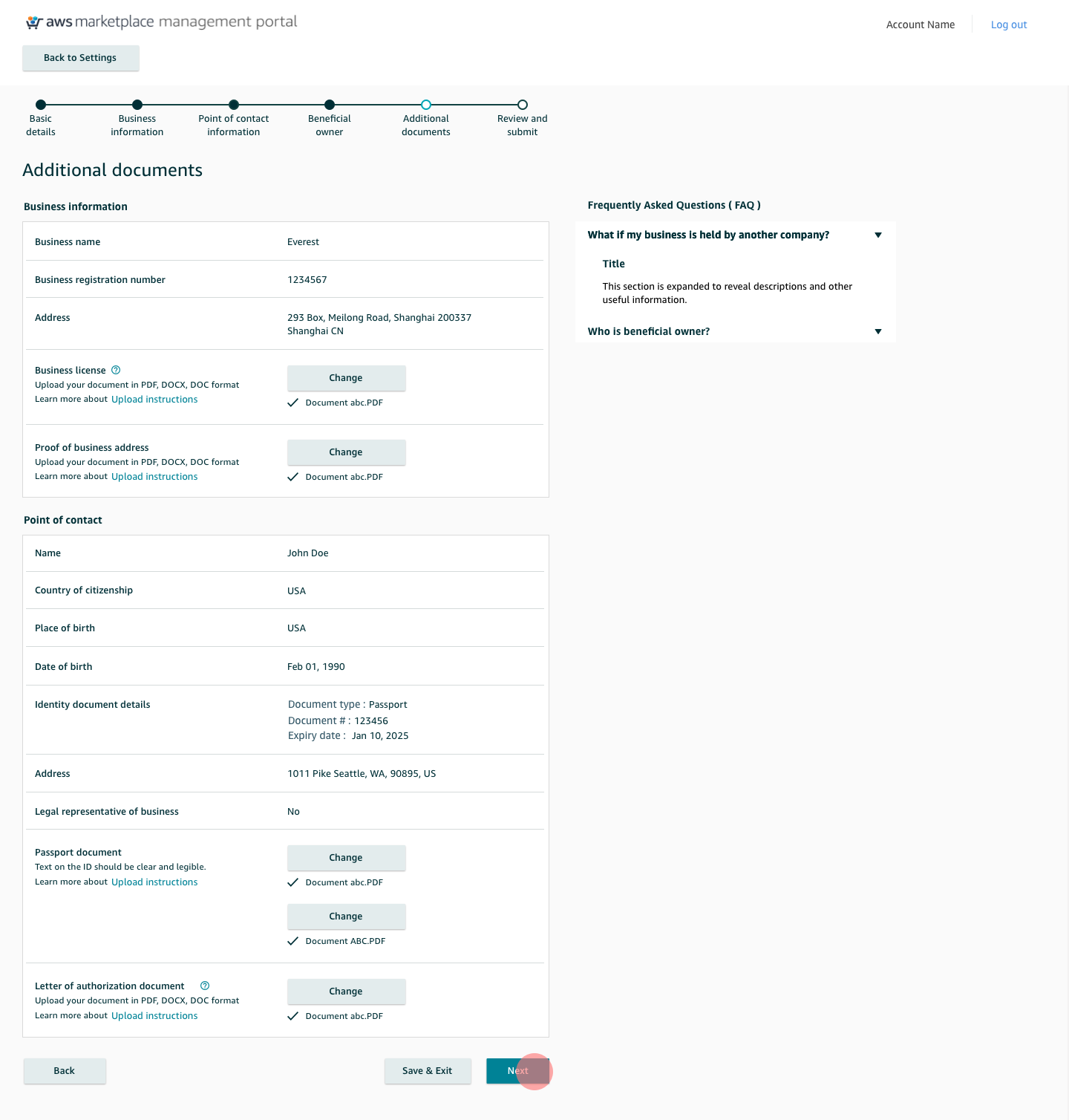
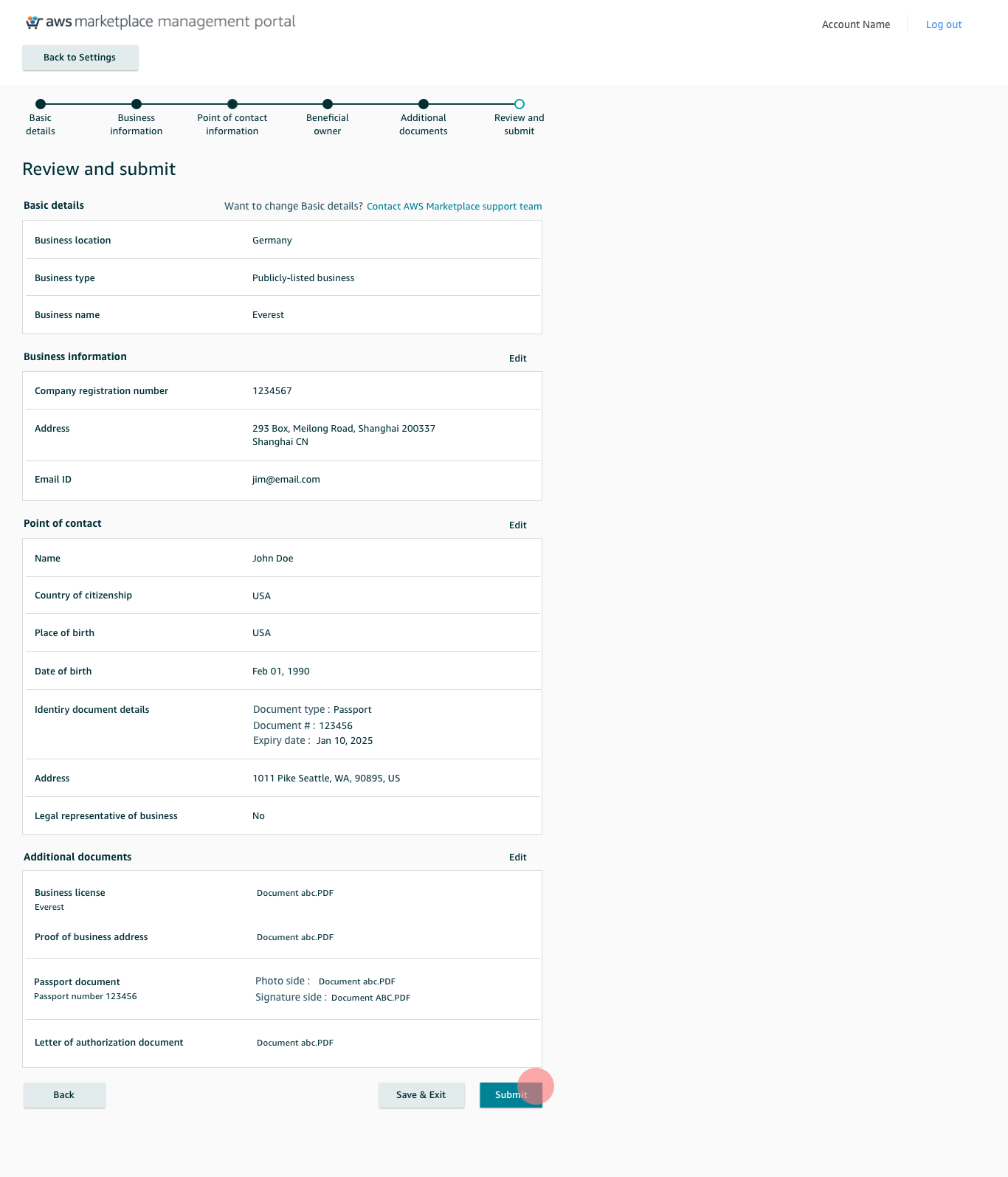
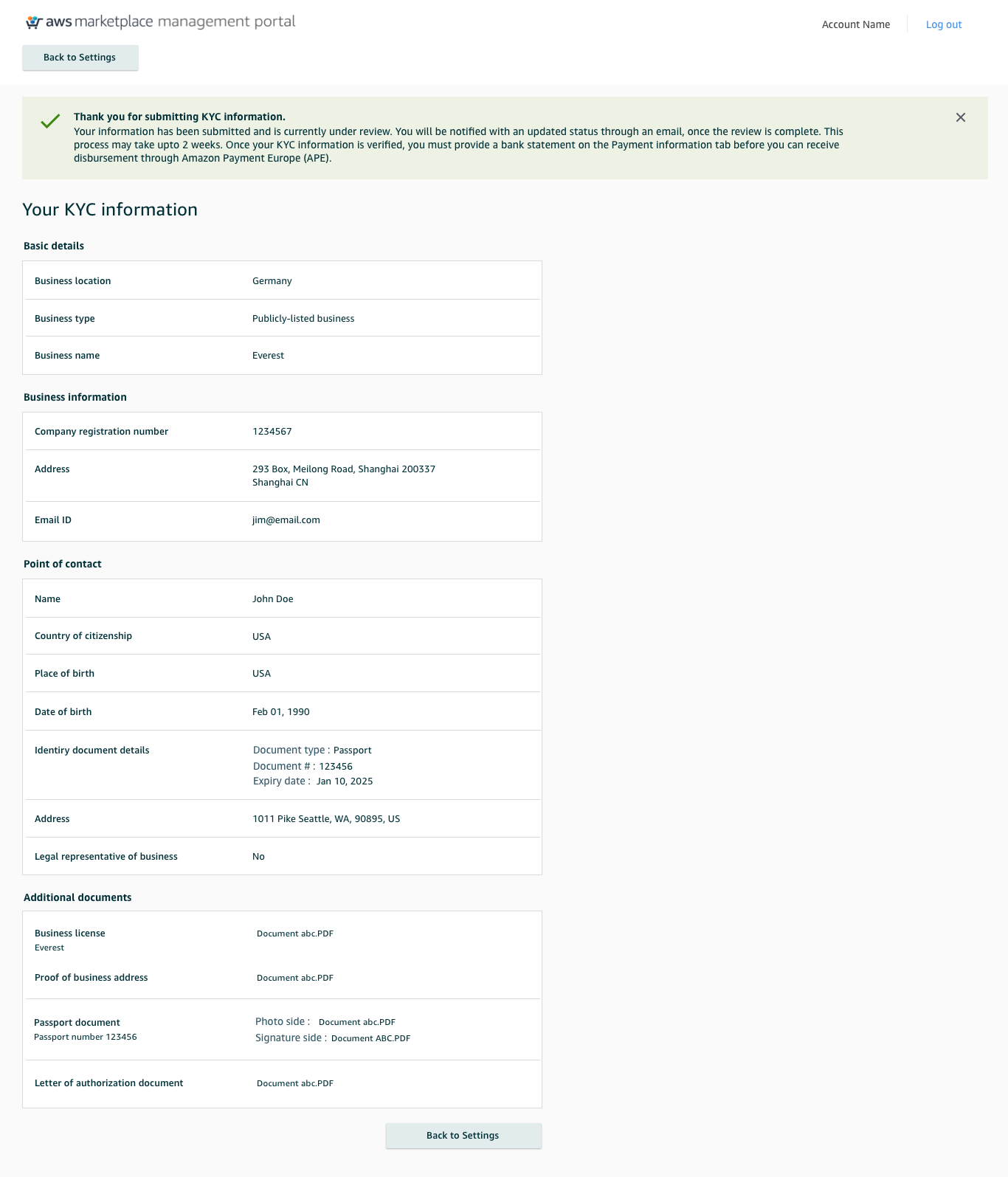
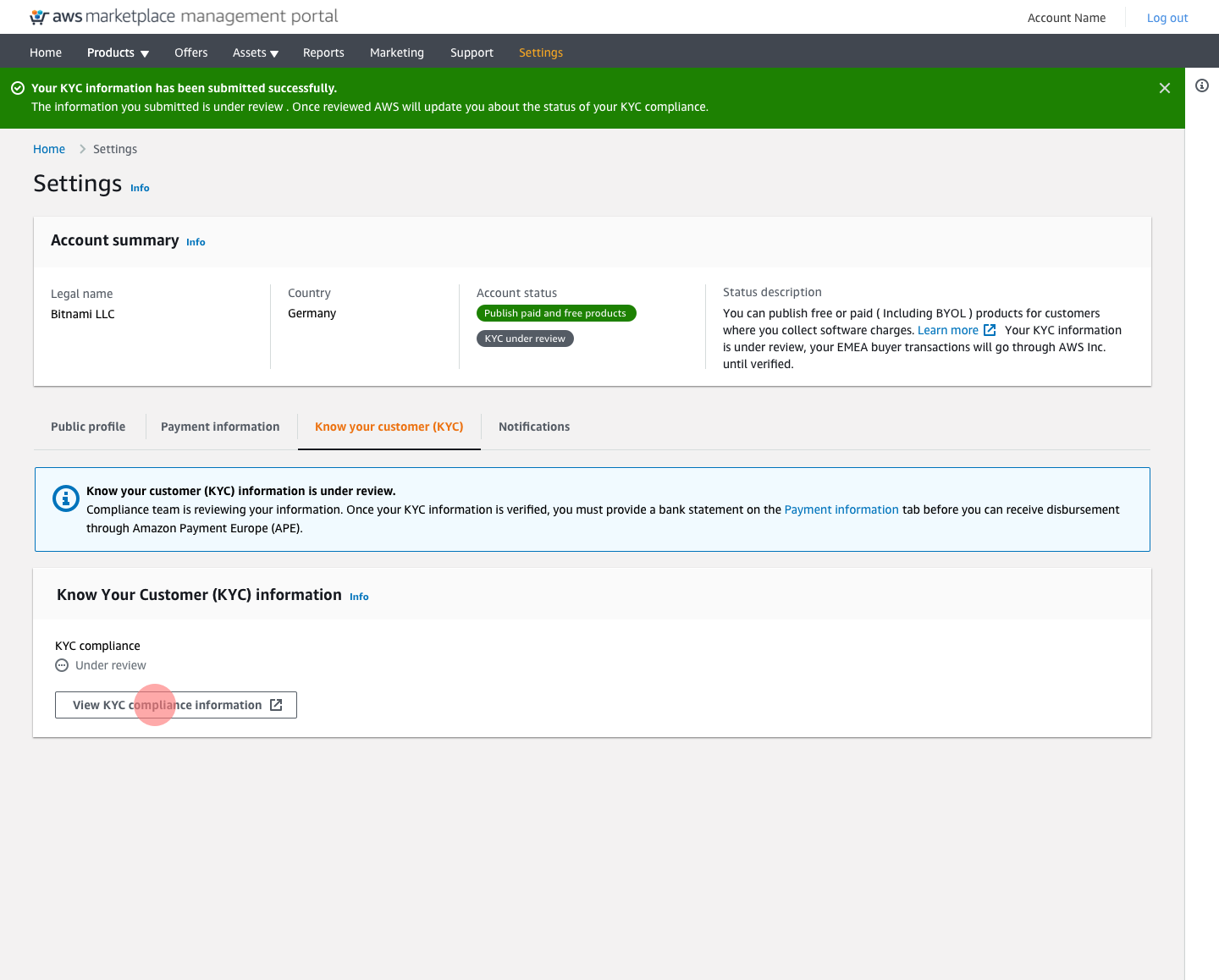
Main KYC - Sellers journey to become compliant to KYC.
After KYC main flow is completed and once their accounts are verified, IAM roles associated with the root account receives request to verify their bank account information.
User testing session was conducted with 5 participants. These participants were from Admins, Finance and business departments.
Overall, participants understood the new additions to the Settings page, and were able to follow the call to action to locate and complete the KYC setup workflow. Participants commented positively regarding the notifications, overview page, badging, help panel, progress indicator, and saving and exiting.
“I like the colors to indicate the things that are on track or not, and the missing information being highlighted. The blue box is helpful with the information, as well as other helpful links. I like how it gives us guiding text on what to expect after it’s done.”
However, participants had significant questions about the KYC program and requirements that would prevent them from completing the setup in one attempt. All three companies reached points where they needed to bring on additional internal stakeholders to review, approve, or provide the documents or terms, for example the agreement, the business license details, or the letter of authorization. Those internal stakeholders included legal, tax, finance, ops. Participants also expressed confusion regarding the information to be entered into the workflow, including who should be the Point of Contact / Legal Representative, which business address and which email addresses should be used (personal vs business, whether it must be related to the seller AWS account, and which countries the business/persons need to be located in). Participants had concern over uploading passport details, considering it to be private personal information and wanting to know more about why it was necessary. Note that the feedback sessions were conducted without the planned documentation, as the documentation was not ready to be shared, and we wanted sellers to tell us the most critical pieces of info that they would need. Most of these issues and concerns should be addressable through documentation, help content, and FAQs, and participants commented in particular that having a comprehensive list of required documents and contacts ahead of time would allow them to get things in place prior to entering the workflow.
100+
INCREASE IN SELLER ONBOARDING:
Sellers selling softwares to buyers in EMEA region with highest Gross software sales opted in KYC program with Beta Launch
80+
SUCCESSFUL SUBMISSION OF KYC :
Within 1 week of beta launch 80/100 sellers in USA and around the globe successfully completed submitting KYC.
1000+
EMEA BUYERS REQUESTED FOR SELLER TO BE KYC COMPLIANT:
Buyers in EMEA region requested sellers to be compliant with KYC which lets them enjoy the benefits of consolidated invoice and tax simplification.